A Queer Berlin Romance
Episode 2 Thoughts Become Things
Aulic Anamika
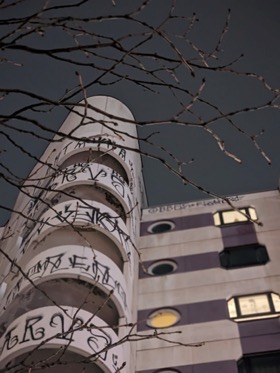
“Thoughts become things. Do they, really? What a strange graffiti!” Amina thought. She was sure it had not been there before. Looked freshly painted. But then, life is strange. Last night’s meeting with the beautiful, kind neighbor and her kitten was strange.
“Wait, wait, wait! It’s too complicated to think so early in the morning. Let me wake up first.” Amina got up from her sofa and went to the kitchen to warm the masala chai she had made and offered to the neighbor last evening. There was still some of that left.
The kitchen retained the aroma of almond milk, cardamom, and cinnamon, mixed with the Assamese tea Amina had bought from her last trip to Kolkata. Kolkata, the woman of her dreams. Deepa! Oh, Deepa!
Amina lived in Kreuzberg, Berlin, in a neighborhood that many regular white Wessies (West Germans), Ostdeutsche (East Germans), and upper-class migrants probably don’t like. The neighborhood of Kotti (shortened version of Kottbusser Tor) is notorious for petty crimes, a drug scene, and street fights. Amina loved her neighborhood and hated it at the same time. It is the only place in the city where she felt at home. Walking on the streets, she fantasized about being in Istanbul, Cairo, Dhaka, Kolkata, or Lahore. Kotti was also famous for its thriving LGBTQI scene. The historical club SO36 was not very far from where Amina lived. She was planning to go out tonight and go dancing.
The thought of Deepa filled her empty stomach with a range of mixed feelings. Longing and regret; anger and lust; attraction and repulsion. The dark eyebrows, a head full of wild dark curls, and those mischievous eyes of her former lover injected into her stomach a desire or hunger. Maybe both?
“Stop thinking about her. Focus on the present. The here and now. And the future. Amina, Amina, Amina…” the inner and wiser voice tried to talk some sense to her.
Amina was not listening. Sipping her masala chai, she walked closer to the window. If thoughts could become things, why was she not in sunny, warm Kolkata, where everyone on the street spoke her mother tongue? Why was she stuck here in Berlin, where the sun was a teasing appearance for half of the year?
“হারিয়ে গিয়েছি এইতো জরুরি খবর…” (I am losing myself and that’s the hottest news…)
The phone rang to interrupt the incessant streaming of her thoughts. Amina returned to the present with a jolt. Deepa called on Telegram from Kolkata.
Amina was spooked by the coincidence. The sun was still shining, and the glaring light fell on the brand-new rainbow graffiti: “Thoughts become things.”
***
“So? Gooottten Mawgen. How are you?” Deepa spoke on the phone.
Amina smiled and said, “Guten Morgen! শুভ সকাল! To what do I do the honor of receiving a call from the busiest artists of the South Asian subcontinent?”
“Oh, wait, bro! Where did that come from?” Deepa had started to call Amina “bro” recently.
Indeed, they were not lovers anymore. But to call each other “bro”??? Not that Amina would also like being called a “sister,” either. But Deepa was just being Deepa.
“Oh, Deep! Stop calling me bro! You know I don’t like that.” Amina always called Deepa “Deep” because the word had a double meaning. Deep meant “light holder” in Bangla and “profound” in English.
“Okay, okay. I won’t call you bro. But you sound so bad mooded! What happened?” “No, actually, I am not. I am very good mooded. You wouldn’t believe what happened last night. I was just thinking about calling you.” It was a partial truth.
“কী ঘটাইেসা আবার? What have you been up to?” Deepa sounded curious. Deepa had always been curious about Amina. Even before they had become lovers, Deepa had encouraged Amina’s efforts to write queer fiction. Being a professional artist, Deepa knew how difficult it was to make a living being one. But then, she had never been good with anything else.
Amina had many choices. She had several degrees, in computer science and creative writing. There were hundreds of ways to make a living as a writer. But Amina always needed financial security. Sitting in front of the machine all day caused her back to be stooped. Amina suffered from constant headaches, burning eyes, and a persistent muscle knot at the back of her left shoulder.
“Hey, what happened? Amina, are you there?” Amina had the tendency to be lost in her thought while on the phone. Deepa’s voice brought her back to the present moment.
“Yes, yes! I am sorry. I was just distracted for a moment.” Amina apologized.
Deepa was aware of this habit of Amina being somewhere else. She never thought that tendency weird but always said to Amina:
“সোনা (Bangla equivalent for “Honey”)! You are between reality and the place from where all of your stories, poems, and songs come from.”
But Deepa knew that Amina was often embarrassed about her absentmindedness. Deepa repeated the phrase she had said to Amina many times before in the last fifteen years that they knew each other:
“Hey, it’s not weird at all. Tell me what happened.”
Amina calmed down and began to tell what had happened last night. How she got freaked out by the fucked-up macho voice, how all that fear and disgust dissolved into a mysterious encounter with the beautiful, kind neighbor and a black kitten. And most importantly, what happened after they both stepped into Amina’s kitchen?
A previous version of this episode of the novella, The Neighbor, appeared in the magazine Swakanthey (In Our Own Voice) published by Sappho for Equality in Kolkata, West Bengal, India, as part of the Birthday Edition, vol. 19, no. 2, June 2022, p. 10. https://www.sapphokolkata.in/publication/magazine.
Aulic Anamika is a poet, writer, and breathworker of South Asian heritage. When they are not writing or telling a story, you will find them offering breathwork and therapeutic storytelling in Casa Kua Berlin, or teaching in a classroom in their social scientist drag. They write and publish in three languages: Bengali, English, and German. Their recent publications include a collection of short stories in Bengali Tara Gune Ki Hoy (Shamabesh, 2024), an English short story “Breathing Becoming Midori” in the anthology Botanical Short Stories: Contemporary Writing about Plants and Flowers (History Press, 2024), and a German poem “Zwischenwelt” in the anthology raumnehmen: Menschen aus asiatisch-diasporischen Communitys in Deutschland erzählen (w_orten & meer, 2025).
 Inter-Asian Berlin Anthology