Chorshanbe Goibnazarov, University of Central Asia
Berlin is a city that never fully settles. Its streets carry traces of empire, war, division, and repair, but they are equally shaped by constant movement. People arrive and leave all the time. For those who come from elsewhere, Berlin can feel open and unfinished. During my years (2010-2014) in Berlin, I came to understand the city not only as a place where I studied, but as a place where small, everyday encounters slowly reshaped how I saw myself and others. This essay argues that Inter-Asia is not only a conceptual or geopolitical framework, but a lived experience, one that takes shape through everyday practices of care, mobility, and interaction in diasporic urban spaces.
Berlin is home to many diasporic communities, including people from Central, South, and East Asia, as well as those who do not fit neatly into any single category. These communities take shape in ordinary places such as small prayer halls on quiet streets, tea houses filled with the smell of black tea and spices, cafes near train stations, and dormitories, which is called “house of nations” where conversations stretch late into the night. In these spaces, Inter-Asia exists through routines, gestures, and relationships.
My life in Berlin moved mostly between two such places. One was the jamoatkhana, an Ismaili Muslim place of worship. The other was the choykhona, especially the Tadzhikische Teestube in central Berlin. At first, these places seemed very different. One was shaped by prayer, ethics, and service. The other revolved around food, hospitality, and long conversations. Over time, however, I began to see how deeply connected they were. Both created worlds of care, memory, and belonging. Both allowed people from different parts of Asia to meet one another beyond national labels and borders. Berlin gathered people who were always in motion, students on scholarships, researchers on short-term fellowships, artists looking for space, professionals on temporary contracts, and refugees living with uncertainty.
In this setting, “Asia” was not something left behind. It traveled with people, in fragments of language, habits, values, memories of food, sounds, and ways of being with others. Identity did not form in isolation. People rarely described themselves only as Tajik, Indian, Afghan, or Chinese. Instead, they spoke in ways what is often in academia described as ‘relational or situational identities’, shaped through ongoing encounters rather than fixed national categories. Certain places made these encounters possible. The jamoatkhana and the choykhona were not just backdrops for social life but they actively structured it through rhythms of gathering, regular prayer times, shared meals, and repeated visits. Differences did not disappear, but they became part of a lived negotiation rather than a barrier.
The jamoatkhana was first a place of prayer, structured by religious practice and ethical values. Yet it was also a space of orientation, especially for newcomers. I remember my first time arriving at this place, standing hesitantly near the entrance. An older member of the community approached me with a greeting and started speaking in Urdu. I realized that he was from Pakistan. I politely replied that I do not understand Urdu, he laughed and said ‘I thought you are from Hunza, Gilgit Baltistan’, as the people of Gilgit Baltistan and Badakhshan share similar facial features. I replied that I was from Tajikistan. Our conversation continued and since I was a newcomer he was asking where I was staying, whether I had registered my address, whether I needed help finding work. Within minutes, others joined, someone from Afghanistan offered to accompany me to the Bürgeramt, if I needed some help, while a woman from India explained how to find a good health insurance. These interactions unfolded naturally, without formal coordination. What brought us together was not nationality, but a shared ethic of care shaped by the jamoatkhana.
In another instance, during a communal meal, I sat between students from Gilgit and Badakshan of Afghanistan. We compared childhood memories of mountain life, different languages, different political histories, yet similar experiences of remoteness, hospitality, and strong community ties. Our conversation moved easily between Burushaski, Dari, Tajik, and English, with occasional laughter when translation failed. In that moment, Central and South Asia were not separate regions, but overlapping lifeworld connected through memory and shared sensibilities. The diversity of the community was striking. Ismailis from Tajikistan, Afghanistan, Pakistan, India, and East Africa gathered together, along with families, friends and visitors from outside the community. Multiple languages, Tajik, Persian, Urdu, Hindi, English, German, circulated within a single evening. Older members carried memories shaped by colonial histories, or East African migration, while younger members brought perspectives shaped by global education and digital connectivity. When these experiences met, they challenged simple binaries such as tradition and modernity.
If the jamoatkhana was shaped by prayer, the choykhona was shaped by time. In the Tadzhikische Teestube, time slowed down. Tea was poured into small cups, bread was broken by hand, and people sat close together on low cushions. For tourists, the space might appear curated. For those from the diaspora, it felt like recognition. I recall one afternoon when we sat at a shared table. Some of us were talking about deadlines and research problems, others spoke about missing home, and a number of us were asking about accommodations issues. When plov was served—a central and widely celebrated dish in Central Asia, often prepared for special occasions—a friendly debate started. We began comparing it to Afghan qabuli and South Asian biryani, and soon the conversations shifted away from issues in Berlin. What began as a conversation about food became an exchange about home, taste, and memory. No one needed to explain what it meant to miss a certain flavor or smell.
Trust in the choykhona grew through presence, through sitting, listening, returning. Its informality allowed for conversations that might not happen elsewhere. People spoke openly about visa anxieties, experiences of discrimination, or the challenges of building a life between worlds. In this sense, the choykhona functioned as an affective space of encounter, where intercultural exchange was not structured by institutions, but by shared time and attention.
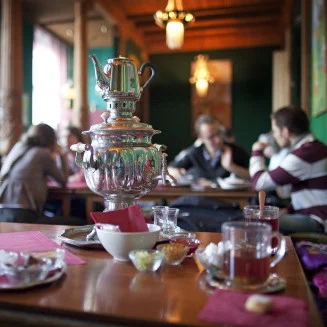
Many of us moved between places similar to the jamoatkhana and the choykhona. What I began to notice was not just the difference between these spaces, but the movement of values across them. Ethics learned through prayer, care, humility, responsibility, were practiced through hospitality and conversation. At the same time, openness cultivated in social spaces shaped how people engaged in religious life. Inter-Asia emerged most clearly in this circulation, when practices, values, and forms of belonging moved across different domains, blurring the boundaries between sacred and everyday life.
My understanding of Inter-Asia deepened during my PhD at the Berlin Graduate School for Muslim Cultures and Societies, where I was part of the Central Asian Seminar at Humboldt University. Yet some of the most meaningful insights came not from seminars, but from friendships. Razak Khan, who is from India and Usman, who comes originally from Afghanistan and lives in Australia became my closest friends. Though we now live in different countries, our connection continues. Dr. Razak Khan and I met as doctoral students and later became neighbors in Wedding. We traveled to the university together, studied in a cafe below our dormitory, went shopping to supermarkets and markets together and shared the routines of everyday life. Outside the university, we spent long hours at a small cafe near Leopoldplatz, drinking Kurdish tea and talking about literature, politics, and life. I remember a difficult period during my first year in Berlin, when I became seriously ill and was hospitalized far from my family. Razak visited me every day. He brought food, sat quietly, and reassured me in moments of uncertainty. In those days, categories such as Central Asia or South Asia felt irrelevant. What mattered was presence. Care was not theoretical, it was lived. These experiences showed me that Inter-Asia is not only something to theorize and analyze, but something that emerges most powerfully in moments of vulnerability. Berlin made these connections possible, but it also exposed their fragility. Visa restrictions, job insecurity, and language barriers which shaped everyday life.
The jamoatkhana and the choykhona taught me that community grows through small, repeated acts such as pouring tea, offering advice, praying together, listening, and returning. Identity remained open, relational, and in motion. Culture was not preserved unchanged, but shared, negotiated, and reshaped. In this sense, Inter-Asia is not only a way of thinking about connections across regions, but a way of living them, quietly, relationally, and through everyday encounters that transform strangers into companions.
Chorshanbe Goibnazarov is an Assistant Professor and Research Fellow at the UCA’s School of Arts and Sciences and the Graduate School of Development. He teaches Cultural Landscapes at the Naryn and Khorog Campuses. He holds a Ph.D. in Central Asian and Cultural Studies from the Institute of Asian and African Studies at the Humboldt University in Berlin, Germany, and a Master of Arts in Muslim Cultures from the Institute for the Study of Muslim Civilizations at the Aga Khan University in London, UK. Goibnazarov was on the Fulbright Visiting Scholar fellowship for the 2019-2020 academic year at the Music Department of Harvard University.
 Inter-Asian Berlin Anthology